
The $87.7M Coordinate - 432 Park Avenue

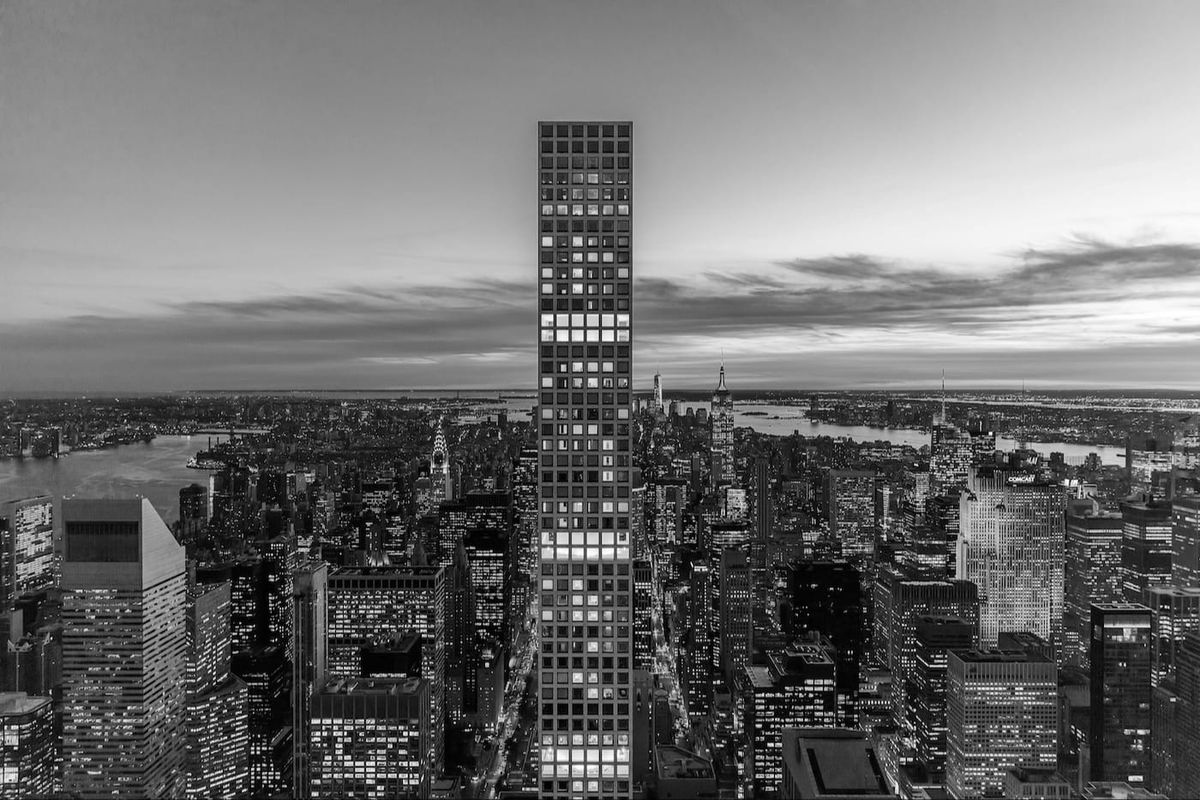
432 Park Avenue in Manhattan stands 426 metres tall, spans 93 structural stories, and contains 104 luxury residences. In 2016, its top penthouse sold for USD $87.7 million. At the time, it was the most expensive apartment ever sold in the United States.
The tower is visible from most of Manhattan and from significant parts of Brooklyn, Queens, and New Jersey. On a clear day, from the upper floors, you can see into Connecticut. Its profile is a perfect square extrusion rising without taper from Midtown's cluttered skyline. It was designed by Uruguayan architect Rafael Viñoly to be unmistakable.
The construction cost was approximately $1.25 billion.
What They Were Selling
To understand the $87.7 million price tag, it helps to understand what 432 Park actually is as an engineering object.
Buildings above 400 metres do not behave like conventional structures. At that height, wind loads are the dominant engineering challenge: the building sways. Managing that sway requires dampers, specific structural geometries, and a floor plate rigid enough to transfer lateral loads without distortion.
It also requires mechanical floors - empty floors placed at strategic intervals throughout the tower's height to house its mechanical systems and serve as structural transfer plates. 432 Park has six of them. These floors generate zero revenue. They consume approximately 20% of the building's total height while producing nothing sellable.
The developers, CIM Group and Macklowe Properties, absorbed that dead weight across the remaining floors that could be sold. The economics only work if the upper floors command prices that essentially have no relationship to construction cost. The penthouse effectively subsidises the mechanical floors, the structural engineering, the lobbies, and the marketing budget.
The Structural & Legal Problems
In 2021, a group of residents filed a lawsuit against the building's board and developer. The $125 million lawsuit filed in the New York Supreme Court documented over 1,500 design and construction defects. A mechanical whine from the building's systems, audible in apartments on multiple floors particularly at night. Elevator failures leaving residents stranded. Flooding in the basement during heavy rain. Creaking and popping sounds from the building's structure as it moved in the wind. Water infiltration around windows and facade elements. In one instance, a chandelier fell in a common area.
A second, more severe lawsuit arrived in April 2025. This $165 million fraud claim centered around the discovery of a 10-inch-deep crack inside the 30-foot concrete structural core that holds the entire tower upright.
The lawsuit alleges that the building's architect and engineers warned the developers during construction that the raw, white Portland concrete facade wasn't strong enough to handle the wind stress without cracking. The engineers recommended coating the exterior in a thick, protective elastomeric paint to waterproof it. Lead developer Harry Macklowe allegedly rejected the coating because he believed an opaque paint would "ruin the building's appearance" and compromise its ultra-luxury, raw-concrete aesthetic.
It's a pretty stark indictment of the building's development philosophy. A remedy was available, but was allegedly rejected on the grounds that the aesthetic purity of the product took precedence over its physical integrity.
The Prices Largely Held
In a standard market, a building facing a combined $290 million in construction defect and fraud litigation (coupled with an allegedly cracked core) would experience a collapse in asset value and a freeze in liquidity.
But at 432 Park, values didn't compress to a level reflective of a compromised asset. Across 229 closings since 2015, the long-term median closing price has held at approximately $4,435 per square foot. From the mid-2010s peak, where averages sat above $4,690 per square foot, the building has recalibrated to roughly $4,034 per square foot through the mid-2020s. A minor ~16% compression despite catastrophic negative press.
In standard real estate, litigation of this scale triggers much steeper write-downs and can halt resale liquidity entirely. Active listings at 432 Park tell a different story. A unit on the 64th floor is listed at $90 million. The penthouse on the 88th floor is asking $88.5 million. Even lower-floor configurations are holding at $3,700 to $4,400 per square foot.
Veblen's Observation
In 1899, economist Thorstein Veblen published The Theory of the Leisure Class. His central observation was that the wealthy consumed visibly, in ways specifically designed to demonstrate their ability to do so. He called this conspicuous consumption.
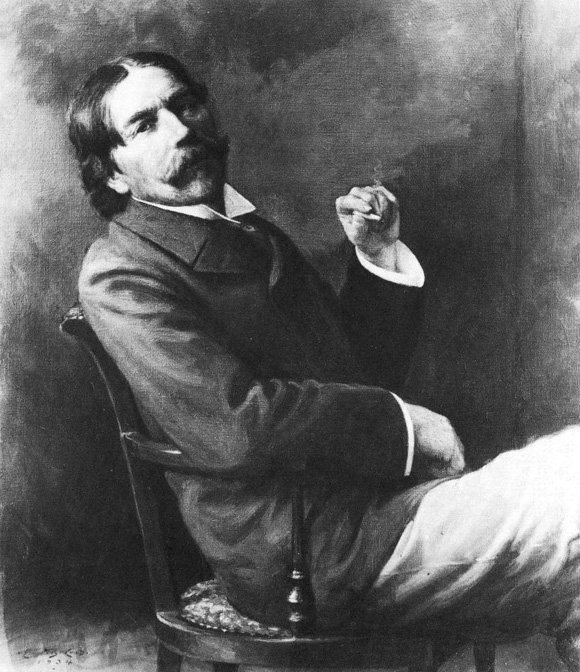
Veblen was writing about Gilded Age industrialists and their carriages and country homes. He would have found 432 Park pretty instructive.
A penthouse at this address is conspicuous consumption taken to its literal physical extreme. The consumption is visible from fifty kilometres in every direction. You cannot make your wealth more legible to a city than by living at the top of its tallest residential tower.
Positional Goods & the Mathematics of Rank
Economists use the term positional good to describe assets whose value is entirely relative to what others have. A positional good isn't valuable because of what it does for you in absolute terms. It's valuable because of where it places you relative to everyone else. This is why the mechanical complaints at 432 Park didn't materially compress the prices. Positional value can dominate product quality. A buyer purchasing position is purchasing a rank which is unaffected by whether the elevator was slow last Tuesday.
The Behavioural Underwriting
There is a specific psychological mechanism driving supertall pricing that goes beyond Veblen's conspicuous consumption.
Loss aversion, the tendency for humans to feel losses far more intensely than equivalent gains, shows up in a specific way at the ultra-high-net-worth level. For a buyer capable of purchasing the penthouse, not purchasing it when the opportunity exists is experienced not as a foregone gain, but as a loss (a social demotion). The category of person who owns the highest apartment in Manhattan is finite and legible. Remaining outside that category, when the financial capacity to enter it exists, registers psychologically as a failure to protect one's status.
Developers understand this even when they don't articulate it in these terms. I doubt the $87.7 million price was derived from a cost-plus model. Instead it was set at the number the developer calculated would attract exactly the buyer who experiences not paying it as a personal inadequacy.
What the Building Actually Sold
432 Park has mechanical problems severe enough to trap its residents in years of ongoing litigation. By the standards applied to any other consumer product, it failed.
But the prices largely held because they weren't actually about the physical building. 432 Park sold a coordinate. The structural engineering and the Rafael Viñoly facade were just the means of establishing that coordinate.


